
Supply Chain Intelligence
The Autonomic Reality: Operationalizing the Apex Architecture
By Dennis Groseclose · Founder & CEO, TransVoyant
Executive BLUF
The end-state of global commerce is autonomic control. The supply chain is going to run itself. Therefore, you must stop buying technology silos. Instead, evaluate systems of systems, and global flow and behavior data. Deploy the Apex Architecture, exploit the data moat, and let the physics run the network.
If you watch CNBC for more than five minutes, you will think every legacy supply chain software company just invented artificial intelligence. The market is currently flooded with vendors desperately slapping “AI-enabled” labels onto 20-year-old applications.
To put it politely, this is a fib.
You cannot bolt a chatbot onto an ageing Transportation Management System (TMS), a Warehouse Management System (WMS), or a basic track-and-trace visibility tool and magically transform it into an AI platform. These siloed point-solutions were built to record discrete historical events. They were never designed to be continuous platforms with their own native streaming data and live intelligence engines. They will fundamentally break down when the supply chain is required to run itself.
For the Fortune 200 and massive government operations, buying another siloed application is a trap. It just builds a more expensive mess. To survive the transition to autonomic supply chains, you must blow up the siloed thinking and operationalize an Apex Architecture.
Here is what the “new world” looks like under the hood.
The Living Data Moat (Laying on Top of the Mess)
Most large enterprises are paralyzed by their own technical debt. They have dozens of disconnected ERPs, legacy application silos, and fragmented databases. The lie that industries and analysts propagate is that you need a massive, multi-year “rip and replace” integration to get clean data.
You don’t. An Apex Architecture is designed to lay directly on top of your siloed mess.
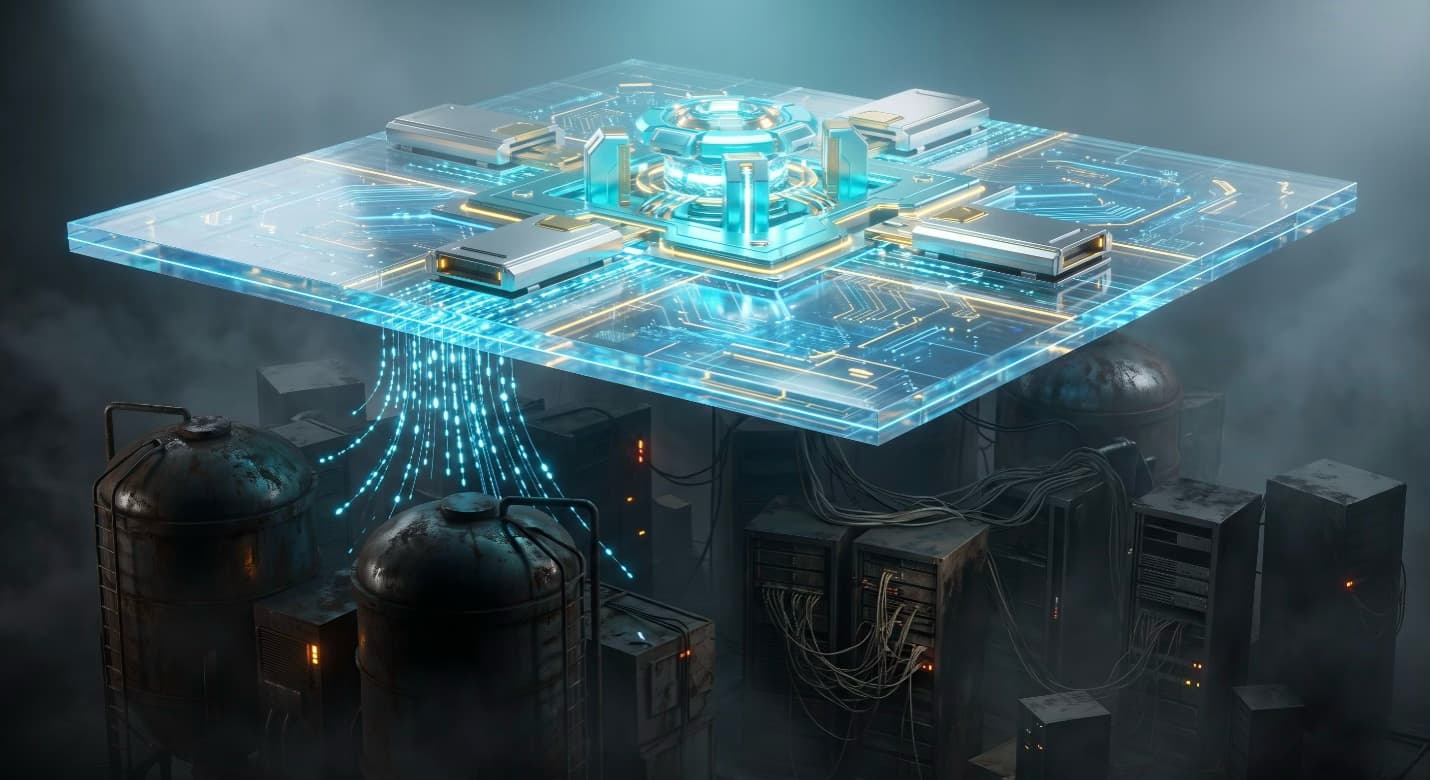
It acts as a universal ingestion layer that continuously streams, cleans, and normalizes everything, including your fragmented enterprise data, your suppliers’ ecosystem data, massive flows of external global signals, and our own 13+ year proprietary data moat of historical supply chain flow and behavior. This creates a single, living, continuously curated baseline of physical reality.
The Hybrid Engine: Deterministic Control Meets Stochastic Context
Once you have the data moat, how do you drive the network? The old world forces you to choose between rigid rules or probabilistic guessing. The Apex Architecture does both seamlessly, by treating the supply chain as a hybrid physical system.
- The Deterministic Core (The Physics): To run a physical supply chain, you need certainty. We use physics-based models and model predictive control to continuously calculate the velocity, mass, and hard constraints of your network. This is the engine that calculates a bottleneck and automatically fires the API command to your legacy ERP to reroute the truck or rebook the customer order.
- The Stochastic Layer (The “Bring Your Own LLM” Engine): Not every problem is an automated re-route; sometimes you need deep contextual investigation. Because our data is flawlessly normalized, you can plug yours, ours and any third-party Large Language Model into the platform using your own enterprise tokens.
This hybrid capability is devastatingly effective. You get the hard, mathematical certainty of a deterministic outcome, combined with an automatic reach-out to an LLM to pull in stochastic background depth. You can ask complex, natural-language questions about global flow across your arcs and nodes, and the platform automatically selects the best LLM to run against both the open-source world, your proprietary baseline, and our proprietary historical and predictive data.
The “Blade” Innovation Cycle
The era of waiting 18 months for a software vendor to release a monolithic software update is dead. An Apex Architecture is built for speed, flexibility, and relentless use-case innovation and execution.
We operationalize this through individual, model-driven applications. We call these applications “Blades.”
- Continuous Engineering: We crank out and test new model-driven Blades every single week.
- Customer-Driven Releases: You select the specific Blades that solve your immediate physical use cases (e.g., thermal decay monitoring, predictive lane routing, quality release, live JIT sequencing, etc.).
- The Deployment: We release the Blades you select into your production baseline once a month.
You are no longer buying static software. Instead, you are subscribing to a continuously compounding innovation engine driven by continuously compounding global data.
The Bottom Line
The end-state of global commerce is autonomic control. The supply chain is going to run itself.
If your foundation relies on visibility for visibility’s sake, fragmented “available to promise” tools, and siloed TMS applications, you are building a house on sand. You cannot fake an AI data moat, and you cannot fake deterministic control. Stop buying silos. Deploy the Apex Architecture, take advantage of the data moat, and let physics run the network.
About the Author
Dennis Groseclose is the Founder and CEO of TransVoyant, a company redefining how we think about global supply chains and national resilience while delivering autonomic, self-aware networks capable of sensing disruptions, anticipating outcomes, and acting in real-time to protect the flow of global commerce.
His career spans the intersection of national security, advanced technology, and commercial innovation. As a senior P&L leader at Lockheed Martin, Dennis built the post-9/11, real-time intelligence programs still used today by the U.S. and Five Eyes (FVEY) partners to secure the global flow of people and commerce. Earlier, as a U.S. Air Force officer and member of the Senior Executive Service, he led programs at the nexus of space, intelligence, and defense technology. A graduate of the U.S. Air Force Academy, he holds an MBA from LSU, an MS from the Air Force Institute of Technology, and is the author of thirteen U.S. and international patents.