
Supply Chain Intelligence
The Long War on Global Supply Chains: An Urgent Call for Predictive Defense
By Dennis Groseclose · Founder, TransVoyant
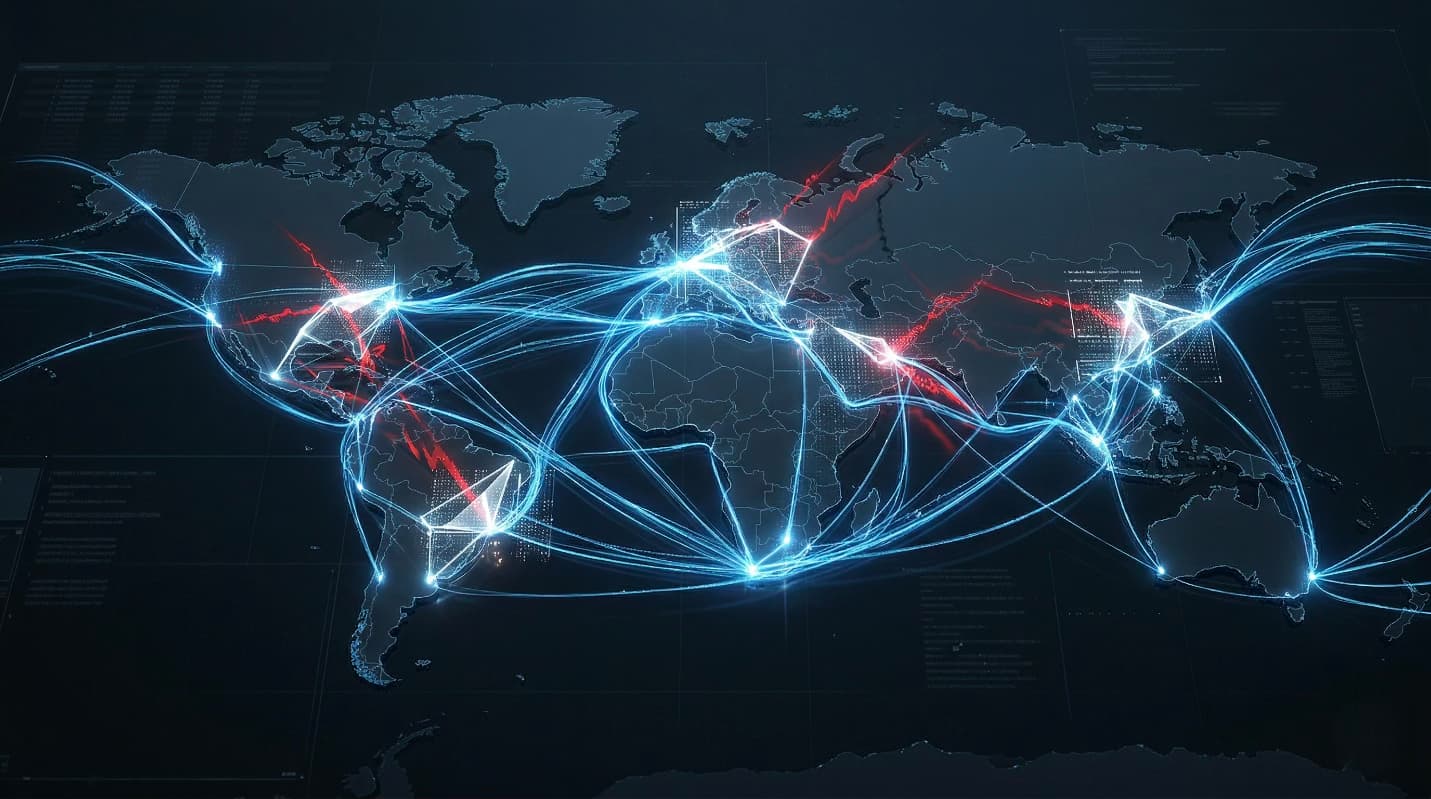
Executive BLUF
The global supply chain is no longer just a mechanism for commerce; it is the primary battlefield for a decades-long, non-kinetic war waged by adversarial states. To survive, the U.S. public and private sectors must abandon static, reactive defenses and adopt predictive, autonomic systems capable of colliding “future vs. future” threats before they materialize.
For nearly three decades, a quiet but persistent war has been waged against the arteries of global commerce. China, Russia, and other state and non-state actors have methodically targeted the world’s supply chains. They do not use missiles or armies. They use the manipulation, control, and disruption of the commercial networks that underpin modern life.
This “long war” has accelerated with a singular goal: erode the complex supply chain systems supporting the United States and its allies, ultimately destabilizing populations, economies, and governments without firing a single shot.
Today, two harsh realities define this battlefield:
- The Multipolar “Pick-Up Game”: The relative predictability of the Cold War has been replaced by shifting, transactional alliances. Nations form and abandon partnerships as interests change, creating massive operational uncertainty.
- The Death of the Old Rules: The post-WWII assumption that economic interdependence deters armed conflict is dead. The rules are being rewritten daily by actors who do not feel bound by them, entirely erasing the line between peace and war.
National security and business leaders must undergo an immediate mindset shift. They must play offense and defense simultaneously against opponents who change players, coaches, and playbooks with every encounter. There is no advance scouting, no game film, and no neutral referee.
China: The Patient First Mover
China has been the long war’s most disciplined player. Its control of critical resources allows extraordinary, weaponized leverage. These are not trade statistics; they are pressure points in the global system:
- 80%+ of the world’s active pharmaceutical ingredients (APIs) originate in China.
- 60%+ of global rare earth refining occurs there.
- 98% of U.S. gallium imports, vital for semiconductors and defense technologies, come from China.
- 60% of the world’s graphite supply, essential for advanced batteries, is produced in China.
In 2024, Beijing tightened export controls on gallium and germanium, deliberately choking semiconductors and defense supply chains. Meanwhile, its $1 trillion Belt and Road Initiative (BRI) has secured influence over more than 100 ports across 60 countries, including a critical trans-shipment hub in the Bahamas, just 55 miles from the U.S. coast.
China understands a simple mathematical truth: commercial disruption is often more corrosive to an adversary’s stability than kinetic warfare.
The Erased Line Between Commerce and Defense
The United States draws a definitive line between government and private enterprise. Our adversaries do not.
The Chinese government directs state-linked enterprises to serve national strategy, deliberately distorting markets and undermining competitors. In the past, the U.S. would never ask a commercial operator to bottleneck a key global trade route. China operates with no such constraints.
This asymmetry strikes at the heart of America’s defense ecosystem. Nearly 90% of U.S. military logistics for overseas operations rely on commercial carriers. The Military Sealift Command operates only a fraction of the tonnage required for a sustained conflict. If the commercial supply chain falls, the military mission fails.
The Private Sector Gap: Awareness vs. Action
The private sector is beginning to recognize the threat, but the response is dangerously slow. According to the National Association of Manufacturers:
- 72% of supply chain leaders now cite geopolitical instability as their top operational risk (up from 28% in 2019).
- Yet, fewer than 30% have integrated real-time, context-aware threat monitoring into their operations.
- Less than 2% have deployed artificial intelligence to detect or anticipate manipulation.
The gap between executive awareness and operational capability is a critical vulnerability.
The Solution: Predictive Resilience and the CSCR³
To close this gap, the United States requires an integrated, autonomic capability to see, simulate, and act on global supply chain threats before they strike.
We need a Critical Supply Chain Risk & Resilience Range (CSCR³).
This public-private-academic partnership must create a continuously automated platform for analyzing physical, digital, and financial networks. It will integrate real-time intelligence across national security and commercial domains, identifying not just what is happening, but mathematically predicting what will happen next.
Through advanced spatial-temporal logic and live global data streams, this proving ground will:
- Fuse public and private data to detect covert manipulation.
- Simulate offensive and defensive countermeasures across global industries.
- Deliver predictive global modeling to autonomously inform mitigation, response, and proactive operations.
CSCR³ will serve as the nation’s first predictive practice field: a dynamic environment to test and prepare for future disruptions before they become operational reality.
The Long War is Here
The long war on commerce is no longer theoretical. It is active, adaptive, and accelerating.
If the United States fails to act with urgency and algorithmic unity across the public and private sectors, we risk losing the war without ever realizing we were under attack. The time for static, dashboard-based defense is over. The future of resilience requires continuous prediction, simulation, and proactive interdiction.
We must jump forward and win the long war through the exact same channels in which it began.