
TRANSVOYANT STRATEGIC INTELLIGENCE BRIEF
The Control Tower Fallacy: Why Passive Dashboards Cannot Command the Global Battlespace
By Dennis Groseclose · Founder & CEO, TransVoyant
EXECUTIVE ABSTRACT
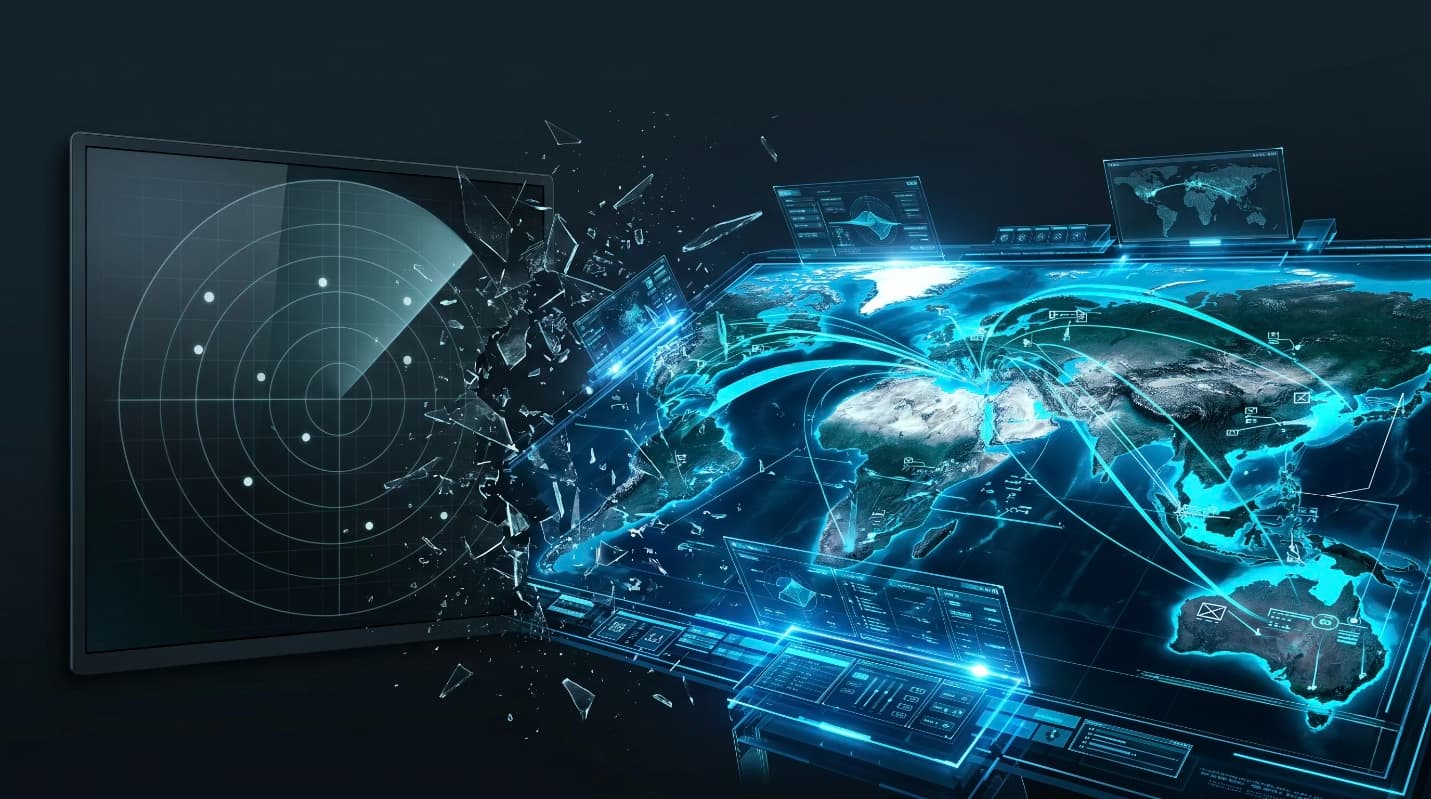
The supply chain software industry has diluted the term “Control Tower” into a meaningless marketing buzzword used to sell passive visibility dashboards. A true control tower does not simply watch assets move; it actively calculates network physics to command the battlespace. To achieve operational dominance, Fortune 50 enterprises must abandon these static screens and deploy Continuous Decision Intelligence architecture capable of autonomic interdiction.
The Core Thesis: A Front-Row Seat to Pandemonium. I am a Gen-X operator who has spent more time as a customer than a “vendor”, so I despise industry buzzwords. If I was awarded a day surfing for every time an executive tossed around the phrase “Supply Chain Control Tower,” I would never work again.
The industry has hijacked the term. Today, most software vendors define “Control Tower” as a web dashboard that aggregates internal purchase orders and plots active shipments on a map. That is not control. That is merely visibility.
When you look at an airport control tower, the people inside are not just watching the planes; they are actively orchestrating the high-velocity movement of assets to prevent catastrophic collisions and ensure the on-time fulfillment of demand. If your supply chain “Control Tower” only gives you a map of where your freight is currently located but lacks the mathematics to calculate global friction and dictate the optimal recovery, you do not have a control tower. You simply have a front-row seat to pandemonium.
Architectural Reality 1: The Visibility Dead-End. Seeing your goods in motion across the Pacific is a tactical necessity, but it is a strategic dead-end.
A true control architecture cannot just track the moving assets; it must calculate the physics of the environment surrounding them and the ecosystem interacting with them. A passive dashboard cannot process the impact of a Category 4 storm, sudden geopolitical border friction, or severe port congestion. If your system cannot instantly calculate how an external labor strike will alter the turnaround time at a specific distribution center, you are blind to the actual operational reality of your network.
Architectural Reality 2: Global Battlespace. To understand what a true apex architecture looks like, you must look beyond the airport and to national security and the defense sector. Think of an AWACS (Airborne Warning and Control System) aircraft operating in a highly volatile theater.
The AWACS crew is not managing static spreadsheets; they are commanding a massive, high-speed physical network of jets, drones, and ground assets (humans and autonomous machines) in a constantly shifting environment. The onboard intelligence matrix continuously assesses the battlespace, calculates threat vectors, and provides immediate, prescriptive interdiction commands.
A Fortune 50 commercial supply chain is no different, it is a global battlespace. Managing it requires the same level of continuous mathematical calculation. You need a AI-enhanced architecture that has watched and modeled global in-node and between-node operations and movements for years, learning the exact throughput and variability of specific nodes and arcs, and calculating the exact capacity constraints of the network under extreme stress.
Architectural Reality 3: The Mathematics of Command and Control. Command and Control is not a heat map. Command and Control is engineered certainty.
When you deploy a platform like the TransVoyant Continuous Decision Intelligence (CDI™) engine, you are deploying the AWACS of the supply chain industry. The CDI™ Engine does not just aggregate data; it runs continuous calculus on the network. It already knows the exact behavior of the carrier or the operation, the historical throughput of the nodes, and the downstream impact of a massive weather system.
When a disruption enters the battlespace, the platform does not simply sound an alarm for a human planner to figure out. It predicts the impact, simulates the recovery, and autonomically pushes the prescriptive rerouting command to the execution layer.
The Strategic Mandate: Stop Watching, Start Commanding. It is time to strip the hype from the “Control Tower” label.
A dashboard that only looks backward is an operational liability. If your technology relies on humans to manually calculate the recovery of a failing network, you are hemorrhaging margin. Supply chain commanders must demand an architecture capable of calculating the absolute physics of their global ecosystem and the world interacting with it. Deploy the CDI™ platform and graduate from passive visibility. Start commanding the battlespace instead.
About the Author
Dennis Groseclose is the Founder and CEO of TransVoyant, a company redefining how we think about global supply chains and national resilience while delivering autonomic, self-aware networks capable of sensing disruptions, anticipating outcomes, and acting in real-time to protect the flow of global commerce.
His career spans the intersection of national security, advanced technology, and commercial innovation. As a senior P&L leader at Lockheed Martin, Dennis built the post-9/11, real-time intelligence programs still used today by the U.S. and Five Eyes (FVEY) partners to secure the global flow of people and commerce. Earlier, as a U.S. Air Force officer and member of the Senior Executive Service, he led programs at the nexus of space, intelligence, and defense technology. A graduate of the U.S. Air Force Academy, he holds an MBA from LSU, an MS from the Air Force Institute of Technology, and is the author of thirteen U.S. and international patents.