
Supply Chain Intelligence
Why Is Shipment Visibility No Longer Enough for LSP Customers?
By Rose Belizor · Marketing, TransVoyant
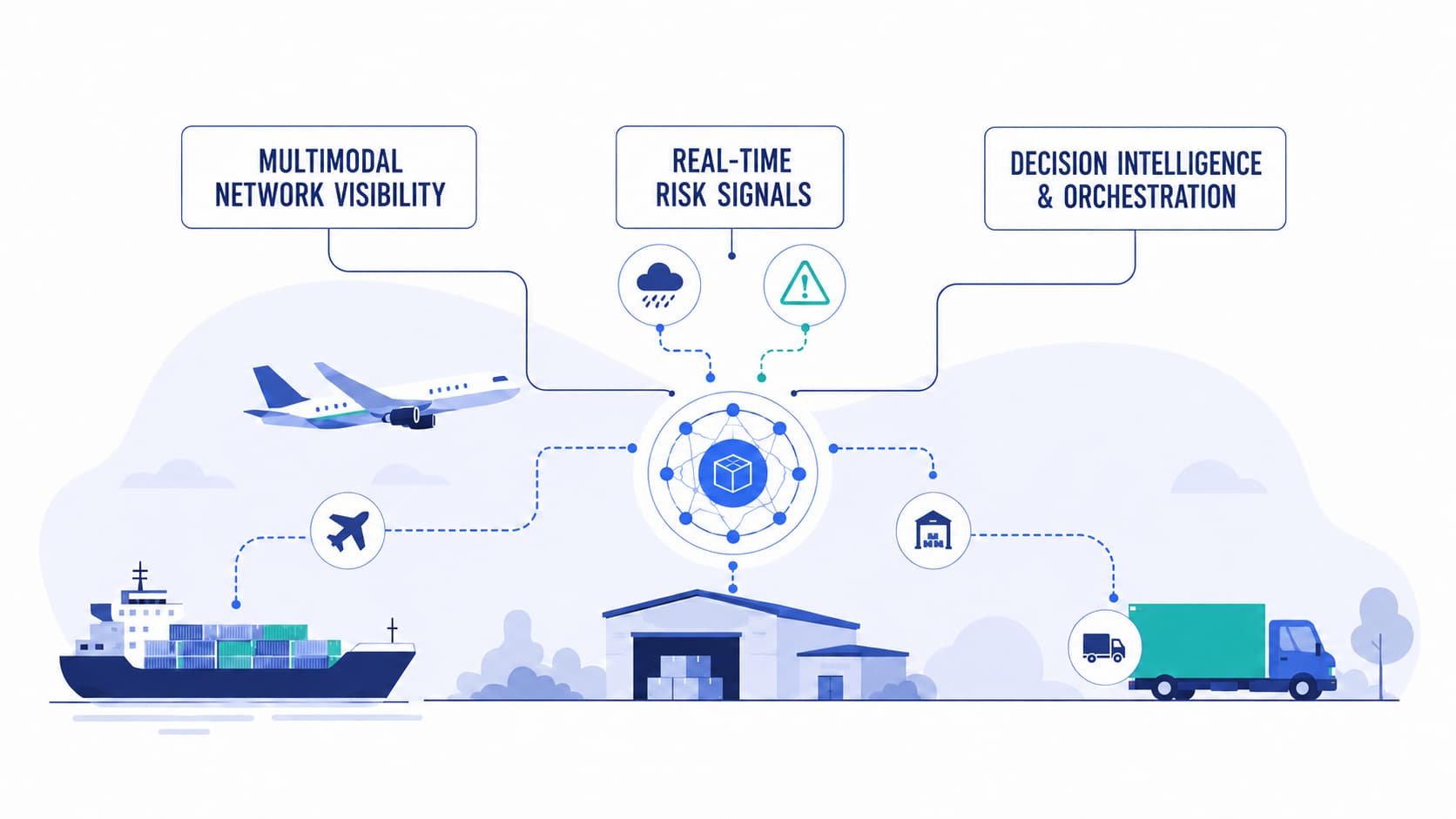
Executive BLUF
For the better part of a decade, “visibility” was the word that sold supply chain software. Shippers wanted to know where a container, pallet, or truck actually was, and logistics service providers (LSPs) built entire value propositions around answering that question. Track-and-trace dashboards, carrier integrations, and real-time location pings became table stakes. If you could show a customer a dot moving across a map, you had a competitive offering.
That era isn’t over, but it has quietly stopped being sufficient. The customers of LSPs (especially manufacturers, retailers, pharmaceutical and life sciences companies, and industrial goods producers), have moved past asking “where is it?” and started asking “what is about to happen, and what should we do about it?” Supply chain visibility isn’t dead, but is now treated as an input rather than an end point: on its own, it’s already obsolete.
Visibility answers the wrong question
Knowing where a shipment is right now tells you almost nothing about whether it will arrive on time, in good condition, or at all. A location ping is a snapshot; it says nothing about the trajectory. A shipment that is “on time” at hour 10 of a 40-hour transit can still quietly head toward a two-day delay if a port ahead is congesting, a storm is forming along the route, or a customs backlog is building, none of which shows up in a GPS coordinate.
This is the core limitation of visibility as most organizations have implemented it: it’s descriptive, not predictive. It reports what already happened, a few seconds or minutes ago, and calls that real time. Genuinely useful supply chain intelligence has to look forward, not just report backward.
Supply chains that lean on latent status updates from legacy communication methods, including EDI transmissions, are no longer competitive. Poor predictability forces supply chain leaders to carry excess buffer stock, make bad inventory allocation decisions, and prevents them from confidently quoting accurate delivery dates to their own customers. That’s not a technology gap so much as a strategic one; companies are managing the past when they need to be managing the near future.
Why this matters specifically for LSP customers
LSP customers, the shippers, manufacturers, and retailers, who hire logistics providers to move their goods, have a different set of pressures than the LSPs themselves. They aren’t graded on whether the truck moved; they’re graded on whether the product landed on the shelf, the drug reached the hospital, or the part arrived at the plant in time to avoid a line stoppage. For them, three practical problems make pure visibility inadequate.
- Visibility is fragmented across a multi-party network. A single shipment might touch a freight forwarder, an ocean carrier, a customs broker, a regional trucking partner, and the shipper’s own warehouse systems, each with its own reporting cadence and format. The biggest barrier to complete visibility for most shippersisn’t a lack of data; it’s insight and data fragmentation across a multitude of enterprise and partner systems. An LSP customer stitching together five different visibility feeds doesn’t have one clear picture; they have five partial ones, often disagreeing with each other.
- Visibility has no line of sight upstream or downstream. Most visibility tools are built to track a single leg or a single mode. Most visibility journeys start by focusing on one segment of the supply chain, lacking insight into events occurring upstream and downstream, which is especially problematic for shippers that depend on inbound materials. A retailer might have excellent visibility into the ocean leg of a shipment andnone at all into the supplier production delay that caused the container to leave port late in the first place. The blind spot isn’t in the tracking technology; it’s in the scope of what’s being tracked.
- Visibility alonecan’tbe turned into a decision. Perhaps the most important distinction is between telling and predicting. A visibility platform can tell an LSP customer that a shipment is delayed. It generally cannot tell them, three days in advance, that it will be delayed, why, and what the best mitigating action is: reroute, expedite, substitute inventory, notify the downstream customer early. That’s the difference between passive monitoring and prescriptive intelligence: insights that don’t just report a status but recommend or trigger a response. The same logic that applies to shipment delays applies just as well to inventory risk, supplier failure, or emissions tracking. A dashboard that tells you what already happened is a passive tool; a system that tells you how to avoid the problem tomorrow is a competitive advantage.
From tracking to trust: the OTIF problem
Much of this shows up concretely in a metric that matters enormously to LSP customers: on-time, in-full (OTIF) delivery performance. OTIF is a lagging indicator if all you have is visibility: you find out you missed it after the fact. It becomes a manageable target only when a shipper can see variability building early enough to intervene. But that process requires modeling supply chain behavior, which answers how a lane, a carrier, a port, typically behaves under similar conditions, then suggesting timelines based on that. It goes far beyond just observing a shipment’s position.
This matters most in industries with low tolerance for delivery failure: pharmaceuticals, industrial manufacturing, defense, and other sectors. A missed delivery for these sectors isn’t just an inconvenience. A stockout of a temperature-sensitive therapy, a halted production line, or a compliance failure can carry costs far beyond a late shipment fee. In cold-chain and life sciences contexts especially, predicting spoilage risk or delay patterns before they happen isn’t a nice-to-have analytics feature; it’s the difference between a delivered dose and a discarded one.
Auditing the network, not just tracking it
One underused capability in this shift is the ability to grade logistics partners independently, rather than relying on their own reporting as the record of truth. If a shipper can validate carrier and LSP performance against independent data, timeliness, accuracy, service-level adherence, visibility data supplied by the LSP itself stops being treated as ground truth by default. That’s a meaningful shift in leverage for the customer, and it’s only possible once an organization has moved beyond passively consuming a partner’s own dashboard.
The industry is already moving this direction
This isn’t a fringe argument. Across the visibility technology landscape, vendors that built their reputations on in-transit tracking are increasingly layering in predictive analytics rather than treating location data as the finished product. The stated goal in many of these partnerships is the same: attack supply chain latency and limited line of sight by continuously collecting, cleaning, and normalizing live supply chain data and applying predictive analytics, enabling firmer customer commitments, optimized inventory, and lower logistics costs. Risk-analytics providers processing tens of billions of data points a day to predict on-time and in-full arrival are chasing the same outcome from a different angle.
Market analysts covering the space now routinely distinguish between platforms built for execution and documentation versus those built for genuinely predictive intelligence, a signal that the category itself has moved, and that pure track-and-trace is no longer viewed as a complete solution by anyone paying close attention.
What this means in practice for LSP customers
The practical takeaway isn’t “replace your visibility tools.” It’s that visibility should be treated as raw material rather than a finished product. The questions worth asking of any visibility investment now include:
- Does this system only tell me where something is, or does it tell me where it’s heading, including risk of delay before it becomes a missed SLA?
- Does it connect data from inside my enterprise (orders, inventory, warehouse) with what’s happening in the outside world along the route?
- Can it turn a prediction into a recommended or automated action, rather than just an alert I still have to interpret myself?
- Am I relying on my LSPs’ own reporting as the record of truth, or do I have an independent way to validate their performance against what actually happened?
None of this makes real-time location tracking obsolete; it remains a necessary input. But the endpoint was never visibility for its own sake. The endpoint is knowing what you don’t know yet, and being able to act on it before it costs you time, service, or money. For LSP customers operating in industries where a missed delivery has real consequences, whether that’s a stocked-out pharmacy shelf, a stalled assembly line, or a broken promise to an end customer, the distinction between seeing and knowing is no longer a nice-to-have. It’s the actual product they should be buying.
About the Author
By Transvoyant Team