
TRANSVOYANT STRATEGIC INTELLIGENCE BRIEF
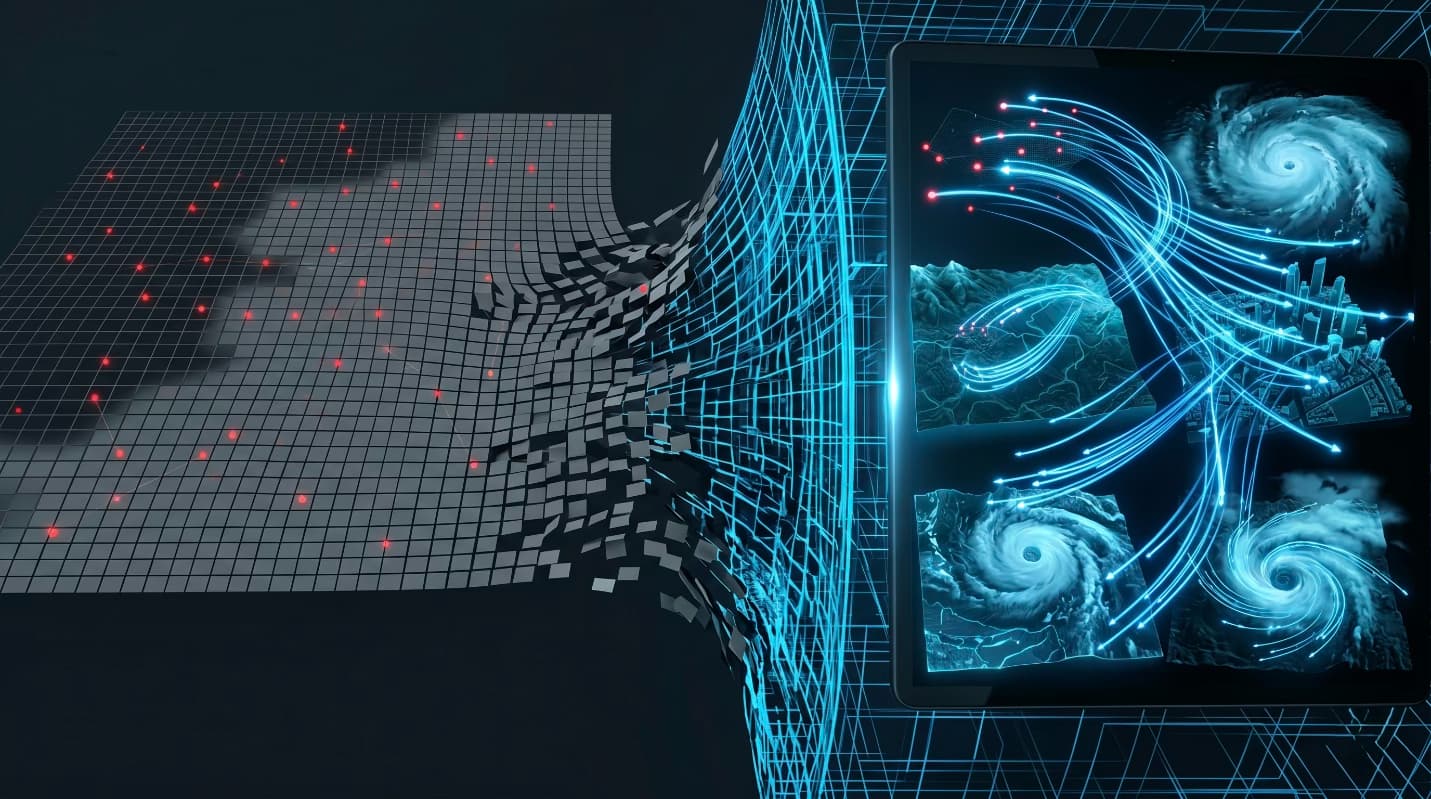
The Visibility Trap: Why "Dots on a Map" Cannot Calculate Supply Chain Physics
By Dennis Groseclose · Founder & CEO, TransVoyant
EXECUTIVE ABSTRACT
The logistics software industry has sold the C-suite a costly illusion: the belief that real-time visibility equates to operational control. It does not. A ping on a map is a passive historical artifact; it tells a commander where an asset was, not what it will do next. To extract trapped capital and eliminate buffer stock, enterprises must abandon passive visibility dashboards and deploy an intelligence architecture that continuously calculates the physical behavior of the global network.
The Core Thesis: The Latency of “Now”. Supply chain professionals readily recognize the value of real-time visibility, but many fail to understand its absolute strategic limit. An IoT ping, a radar sweep, or a smartphone GPS signal provides a real-time picture of a conveyance in motion. But a ping is merely a snapshot in time.
Knowing exactly where a container ship is currently sitting in the Pacific Ocean is tactically interesting, but strategically useless. If you do not know the exact minute that container will clear customs, physically detach from the port crane, and be available for drayage, you cannot optimize the physical handoff. The container sits in the yard bleeding demurrage margin, waiting for a human to notice it has arrived.
Real-time visibility is a means to an end, but it is entirely passive. It forces the enterprise to react to the present. Meeting the strategic goal of minimizing global inventory requires predicting the future. It requires moving beyond the passive tracking of hardware and executing the continuous, mathematical calculation of network physics.
Architectural Reality 1: The Multi-Variable Calculus of Flow. A commercial supply chain does not operate in a vacuum, and it does not move in a straight line.
Legacy visibility tools calculate ETAs by simply dividing distance by the average speed of a carrier. This is high-school algebra, and it fails the moment it hits reality. An apex predictive architecture must calculate the dependent variables (e.g., the ocean carrier’s momentum) against massive sets of independent, volatile variables.
What is the historical probability of this specific carrier making an unscheduled port stop when spot rates fluctuate? Exactly how much velocity is lost when an ocean vessel encounters an 18-foot swell for four consecutive days? What is the throughput degradation at a specific distribution center when a local sporting event creates a localized traffic chokepoint? You cannot answer these questions by looking at a dot on a map. You must deploy an engine that continuously calculates the behavioral physics of the nodes and lanes.
Architectural Reality 2: The Algebraic Constraints of the Node. The highest physical friction in a global network occurs at the nodes. These are the factories, the ports, the borders, and the distribution centers.
A visibility dashboard will tell you your vessel has arrived at the Port of Long Beach. It will not tell you the algebraic constraint of that port. How long does it take for a vessel to berth and unload when there are 10 vessels anchored offshore versus 40 vessels? How long does it take to unload a truck at a DC when there are seven dockhands working instead of ten, and eight trucks arrive within a 30-minute window?
An intelligence architecture observes these physical behaviors millions of times over time, establishing ironclad mathematical models for node capacity and behavior. It predicts the choke-point weeks before the physical asset arrives.
Architectural Reality 3: Buffer Stock is a Penalty for Bad Math. When an enterprise lacks predictive certainty, it protects its Service Level Agreements (SLAs) by hoarding inventory. Buffer stock is simply a financial penalty paid for a lack of mathematical precision.
When you deploy predictive intelligence fueled by global physical behavior, the financial impact is absolute. By calculating the actual physics of the network, the TransVoyant Continuous Decision Intelligence (CDI™) platform delivers predictions that are 50-80% more accurate than legacy systems or ecosystem partners.
This is not a theoretical metric. On an ocean journey, that accuracy translates directly into the extraction of 3 to 5 days of wasted cycle time. Across an end-to-end global supply chain, from a foreign supplier to the customer door, commanders routinely compress their networks by 7 to 10 days.
The Strategic Mandate: Command the Physics. It is time for the C-suite to realize that “Control Towers” that only provide real-time visibility offer no actual control.
Understanding the real-time location of your asset is the absolute bare minimum for survival. If your enterprise architecture is not continuously calculating the spatial-temporal physics, weather impacts, and node constraints of your global network, you are operating blind. Stop paying for dashboards that tell you what is happening right now and deploy an autonomic engine that mathematically calculates what will happen tomorrow.
About the Author
Dennis Groseclose is the Founder and CEO of TransVoyant, a company redefining how we think about global supply chains and national resilience while delivering autonomic, self-aware networks capable of sensing disruptions, anticipating outcomes, and acting in real-time to protect the flow of global commerce.
His career spans the intersection of national security, advanced technology, and commercial innovation. As a senior P&L leader at Lockheed Martin, Dennis built the post-9/11, real-time intelligence programs still used today by the U.S. and Five Eyes (FVEY) partners to secure the global flow of people and commerce. Earlier, as a U.S. Air Force officer and member of the Senior Executive Service, he led programs at the nexus of space, intelligence, and defense technology. A graduate of the U.S. Air Force Academy, he holds an MBA from LSU, an MS from the Air Force Institute of Technology, and is the author of thirteen U.S. and international patents.