
Supply Chain Intelligence
The Zero-Tolerance Cold Chain: Engineering Mathematical Certainty for Critical Payloads
By Dennis Groseclose · Founder, TransVoyant
Executive BLUF
In the pharmaceutical and high-value cold chain, reactive temperature monitoring is an autopsy, not a strategy. To protect volatile payloads and eliminate catastrophic margin loss, enterprise leaders must transition away from passive hardware tracking. Shifting to autonomic intelligence architecture allows mathematic prediction for thermal excursions and perfectly synchronizes physical handoffs.
The cold chain is a high-stakes physics problem. When you are moving life-saving pharmaceuticals, biologics, or highly volatile chemicals, the implications of a poorly monitored network go far beyond financial write-offs. A single thermal excursion can result in the destruction of a critical payload or, worse, a catastrophic threat to patient safety.
For decades, the industry’s response to this risk was simply to add more hardware by slapping GPS and GSM-enabled sensors onto pallets and hoping for the best.
But hope does not protect the payload. Relying exclusively on physical sensors is a reactive posture. If a sensor alerts you that a shipment has fallen outside of its temperature tolerance, the damage is already done. The product is dead. True supply chain defense requires moving left of the failure. It requires predicting the excursion before it happens and autonomously orchestrating the physical network to prevent it.
Here is how the Continuous Decision Intelligence (CDI™) platform architects a zero-tolerance cold chain.
1. Weaponizing the Sensor Feed
Real-time IoT sensors are critical, but they are not the solution. The are merely the telemetry feed.
When you deploy sensors, you are establishing a ground-truth baseline of the payload’s condition. The true value of this baseline isn’t unlocked by watching temperatures fluctuate on dashboards, but in converting that live telemetry directly via a predictive machine learning engine. By constantly monitoring the exact physical state of the payload and combining it with external environmental and risk data, the architecture transforms raw data into actionable intelligence.
2. Calculating Predictive Thermal Physics
Even with real-time alerts, a cold chain commander often cannot marshal the physical resources fast enough to save a decaying payload in a remote location. You must be proactive.
The TransVoyant platform peers forward along the spatial-temporal route of the shipment. It mathematically calculates the forecasted external temperatures, weather patterns, and route friction against the specific thermal tolerances and degradation curves of the individual SKUs inside the container.
If the engine calculates that a specific route will expose the payload to a thermal excursion 48 hours from now, it does not wait for the temperature to rise. It prescribes a physical interdiction, whether recommending a route deviation, an immediate lane shift to a highly controlled reefer network, or an action in the warehouse upon arrival. In this way, the CDI™ Engine bypasses threats entirely.
3. Mastering the “Kill Zone”: Spatial-Temporal Synchronization
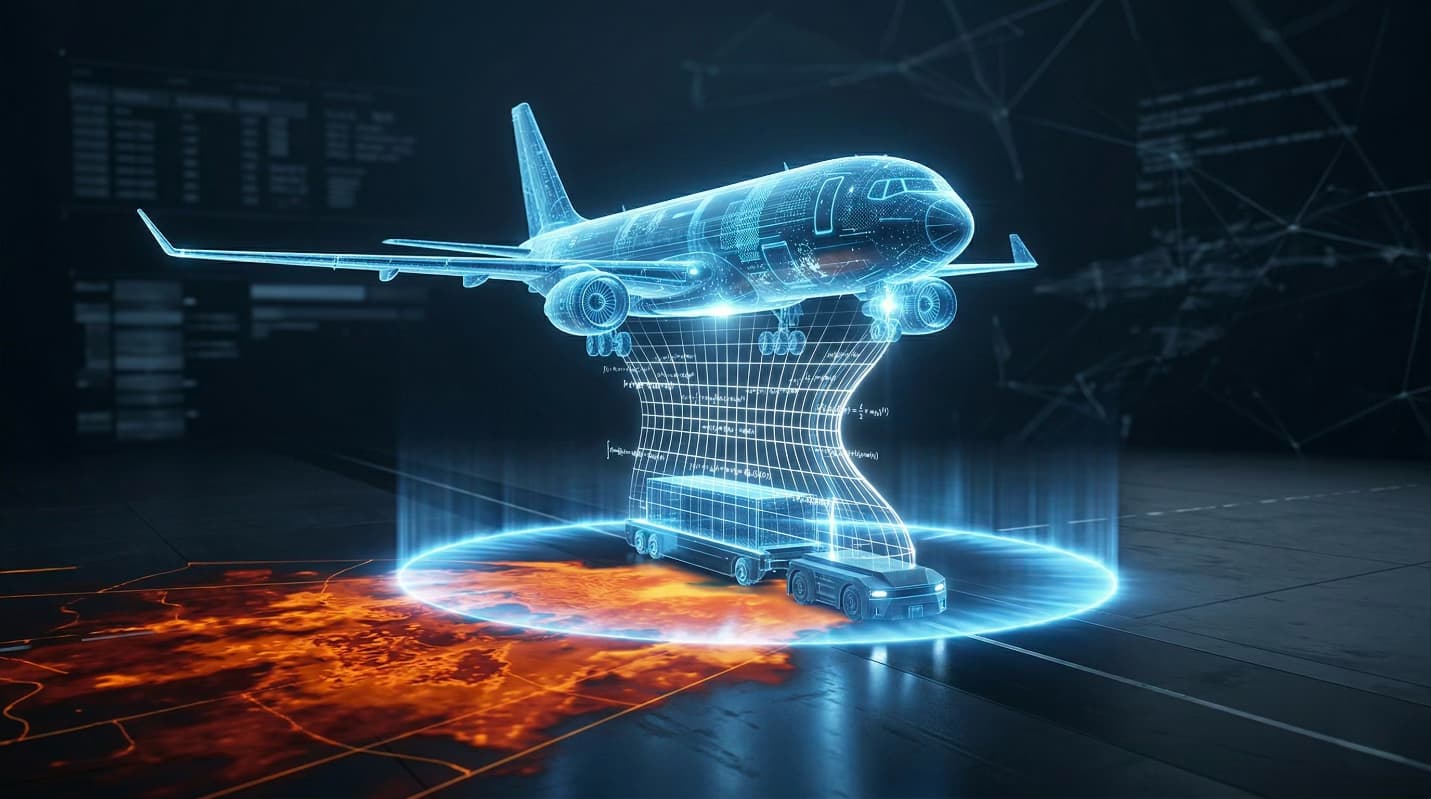
The absolute weakest link in any cold chain is the transfer point. The tarmac, the loading dock, and the customs warehouse are the “kill zones” where goods change transportation modes.
When a multi-modal handoff is not mathematically synchronized, the payload sits idle. Leaving temperature-sensitive cargo to bake on a 100-degree tarmac just because the drayage carrier is late is a failure of an entire network’s architecture.
The CDI™ platform eliminates this vulnerability by continuously calculating the Predicted Time of Arrival (PTA) at all transfer nodes. It factors in learned behavioral models, port congestion, and flight delays to generate a predictive timeline that is vastly more accurate than carrier-provided ETAs.
Armed with this precision, the platform orchestrates absolute, just-in-time handoffs. The ground transport does not arrive based on a static schedule; it arrives based on the exact, dynamically calculated physics of the inbound aircraft. The payload never dwells. The cold chain remains unbroken.
A modern digital supply chain is not about tracking boxes. It is about continuously modeling the physics of the global network to eliminate choke points, eradicate dwell time, and guarantee the survival of the world’s most critical goods.
About the Author
Dennis Groseclose is the Founder and CEO of TransVoyant, a company redefining how we think about global supply chains and national resilience while delivering autonomic, self-aware networks capable of sensing disruptions, anticipating outcomes, and acting in real-time to protect the flow of global commerce.
His career spans the intersection of national security, advanced technology, and commercial innovation. As a senior P&L leader at Lockheed Martin, Dennis built the post-9/11, real-time intelligence programs still used today by the U.S. and Five Eyes (FVEY) partners to secure the global flow of people and commerce. Earlier, as a U.S. Air Force officer and member of the Senior Executive Service, he led programs at the nexus of space, intelligence, and defense technology. A graduate of the U.S. Air Force Academy, he holds an MBA from LSU, an MS from the Air Force Institute of Technology, and is the author of thirteen U.S. and international patents.